This is not what I usually draw or paint. It's quite small (6" x 4"), it has lots of fine details, it's very photographic, it doesn't have water, reflections, distortion, flowers or pebbles, and it's not made with the Icarus Drawing Board.
So, why did I do it and what have I learned from this experience?
Well, I did it as my contribution to the Los Angeles Colored Pencil Society Chapter project. We are putting together a compilation of small drawings of common California trees for the CPSA Convention in Dallas, Texas. I chose the eucalyptus tree because it grows everywhere in my area and it has a very attractive, colorful bark.
The drawing is so small and detailed that I really couldn't use the Icarus board nor any other wax-based media besides colored pencil. What I learned from this experience is that it's good for an artist every once in a while to do something out of the norm.
Doing this small drawing reminded me how I really enjoy working big.
The Icarus board would have allowed me to accomplish a much larger version in the same amount of time, especially with the addition of artist crayon or oil pastel.
Photorealism is not my cup of tea.
I missed pushing the colors as far as I usually do.
I truly missed the magic of water.
I just can't wait to go back to my technique and artistic direction.
See you all in Texas in 10 days. Stop by the CPSA TRADE SHOW where I will demonstrate the Icarus Drawing Board.
Saturday, July 16, 2011 - 9:00 am – 2:00 pm
Renaissance Hotel, Richardson, Texas 75082
"Daydream" is the artwork that I will be donating to the Colored Pencil Society for its Silent Auction. This event, which will take place during the 2011 Convention in Dallas, TX, is called "Small Works of Great Magnitude".
Daydream
9" x 9" - Wax-based Media (Colored Pencil)
Created with the Icarus Drawing Board.
The list of invited artists to the Colored Pencil Society of America 19th Annual Exhibition is finally out! I'm thrilled that my piece "Social Network" has been juried into the show by juror Bob Malenfant, director of South West Gallery in Dallas. The exhibition will be at the Charles W. Eisemann Center in Richardson, Texas, from June 29 to July 31.
On Saturday, July 16, from 9:00 am to 2:00 pm, I will have a booth at the Convention Trade Show, where representatives from many companies will be showing off new products and old favorites. I will be working with the Icarus Drawing Board to demonstrate how to use it and be available to answer all your questions. Please stop by to say hi and to play with the Icarus board.
For my workshop attendees this is a great opportunity to review the techniques learned last summer. For everybody else it's like taking a workshop for free. All voiced-over video clips are available in high definition and come with a downloadable supply list, an outline of the project, and an image of the finished mussel shell.
I hope you all enjoy practicing and/or learning the Icarus technique. You are always welcome to post comments and ask questions either on this blog or on YouTube.
22" x 28" - Wax-based Media (Colored Pencil and Artist Crayon)
Created with the Icarus Drawing Board.
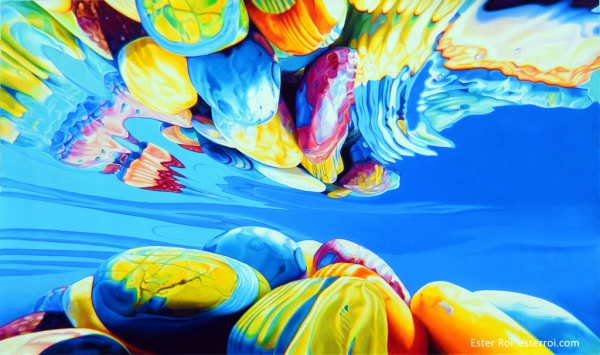
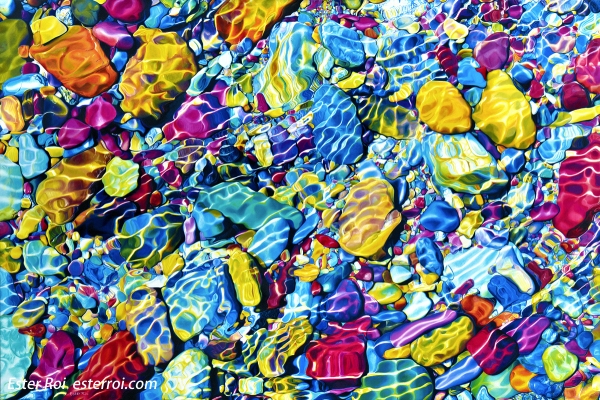
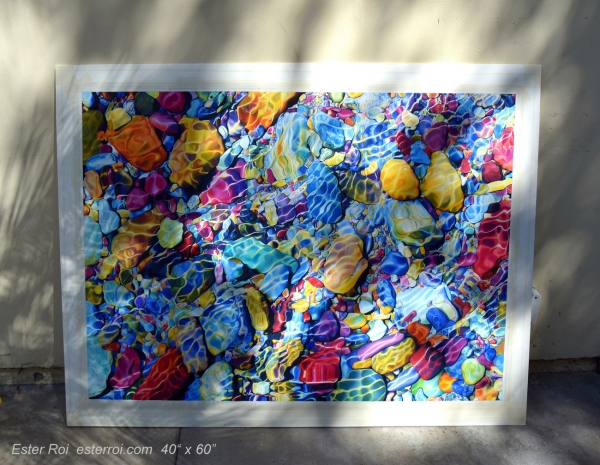
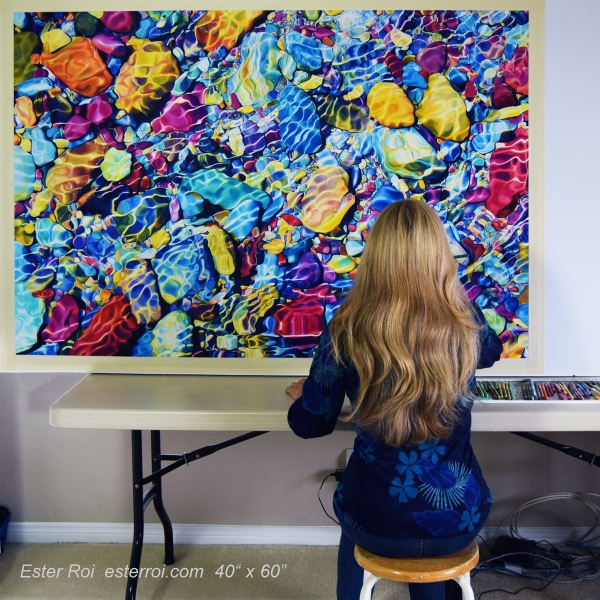
I finished this piece just in time to enter it into the 19th Annual CPSA Juried Exhibition. There's something about this group of pebbles, linked together by water, that reminded me how we are all connected, socially and otherwise.
This year the Colored Pencil Society Convention will be in Dallas, Texas. I will be demonstrating the Icarus board at the CPSA trade show Saturday, July 16, from 9:00 to 2:00.
I have a short demonstration coming up on Saturday, April 30th, in conjunction with the Los Angeles CPSA district chapter meeting. Click this link for directions.
Icarus Art is now on YouTube. The first series of video clips is a short introduction to the Icarus Technique and the Icarus Drawing Board. You can see how I organize my workstation and how I use some of my favorite tools.
I have also posted a video on how to create a monotype with the Icarus Board.
This is just the beginning. I will upload more videos soon.
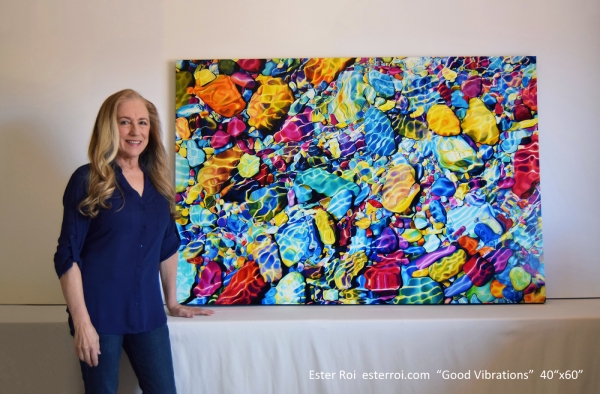
I'm working on a very detailed pebble piece. I'm combining Prismacolor colored pencil, Neopastel oil pastels & Neocolor artist crayons on Colourfix paper. I'm eager to show you a small (2"x2"), abstract close-up of my painting (18"x18") and explain the shortcuts I've taken to get around all the details.
1. Photo Cropping
2. Line Drawing
1. This is a cropping of the original photo. Even though it's very blurry you can still see all the intricate details.
2. On my line drawing I focus on the essential lines and not the confusing details.
3. Blocking-in Colors
4. Melting
3. On the cool zone I block-in the colors with a combination of oil pastels and artist crayons.
4. I move my artwork to the warm zone of the Icarus board (high temperature) and melt all the colors with a color shaper. The waxy pigments settle into the hills and valleys of the paper, leaving plenty of texture for further layering.
5. Preparing Eraser
6. Lifting Color
5. I'm preparing my Sakura battery-operated eraser by cleaning and flattening the tip on sand paper.
6. Here you can see how easily the pigment is lifted from the surface. By using the flat edge of the eraser point, I can achieve a very fine line.
7. Lifting Color
8. Finishing
7. I lift all the waxy pigments until the white of the paper shows through.
8. I can now develop the colors and values and finish the details with colored pencils. During this phase I lower the Icarus Board temperature to a medium setting.
This shortcut allowed me to work from "large" to "small" without getting bogged down in details too early in the process.
On step #1 I layer on the cool zone process red, pink and white colored pencils over light blue artist crayon (see more on "layering" on previous post). I use the side of the pencil, not the point.
After moving the paper to the warm zone I start blending with a paper stump. Here, again, I’m using the side, not the point, and make small circles as I blend. Step #2 shows you the blending in progress.
On step #3 you can see the end result: a very smooth and flawless color gradation. This technique will allow you to blend a large area in a very short time.
As you can see on step #1, it’s impossible to layer a hard medium over a softer one. The pink colored pencil can only make indentations and scratches over the light blue artist crayon. Here is where the Icarus Drawing Board can help you.
On step #2 the thick layer of crayon is thinned out on the warm zone with a gray paper stump. I use the side, not the point of the paper stump and make small circles until I'm left with a thin, saturated layer of color.
After moving the paper to the cool zone, I’m now able to easily layer colored pencil over artist crayon (see step #3).
#1 - Layering Colored Pencil Over Artist Crayon or Oil Pastel
#2 - Layering Colored Pencil Over Artist Crayon or Oil Pastel
#3 - Layering Colored Pencil Over Artist Crayon or Oil Pastel
I am an artist and inventor living in Southern California. On this site I post new artwork, chronicle my progress as an artist, and keep you updated on my invention, the Icarus Drawing Board®. The Icarus Technique, where wax-based media is softened or melted on a heated drawing board, is the perfect method to achieve the smooth gradations and dissolving hues that permeate my art.