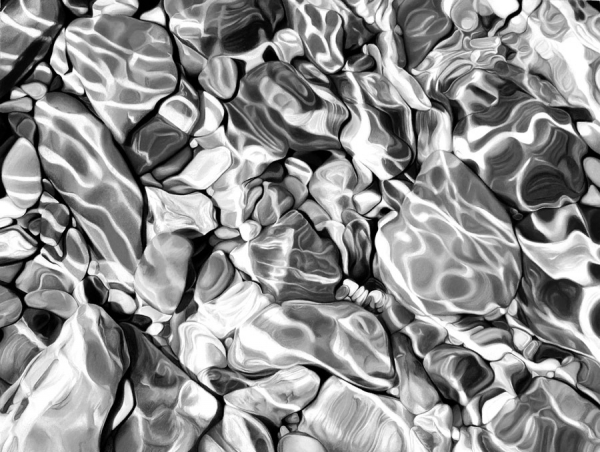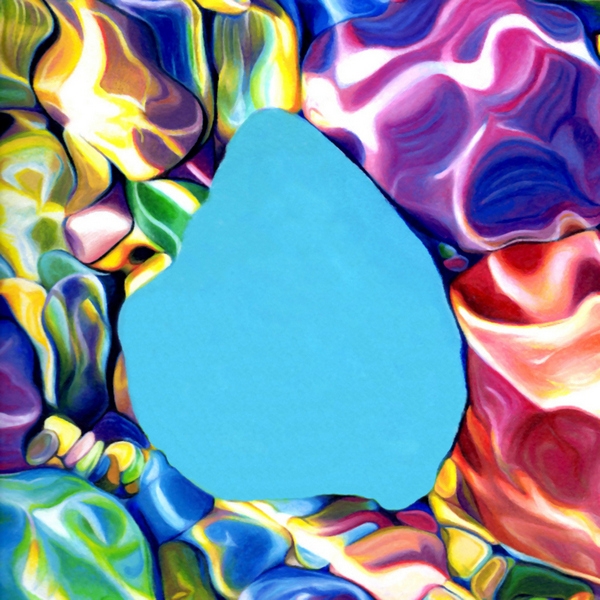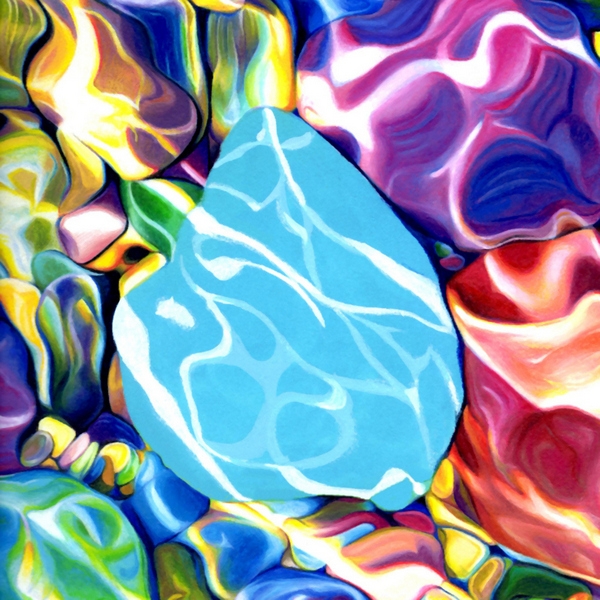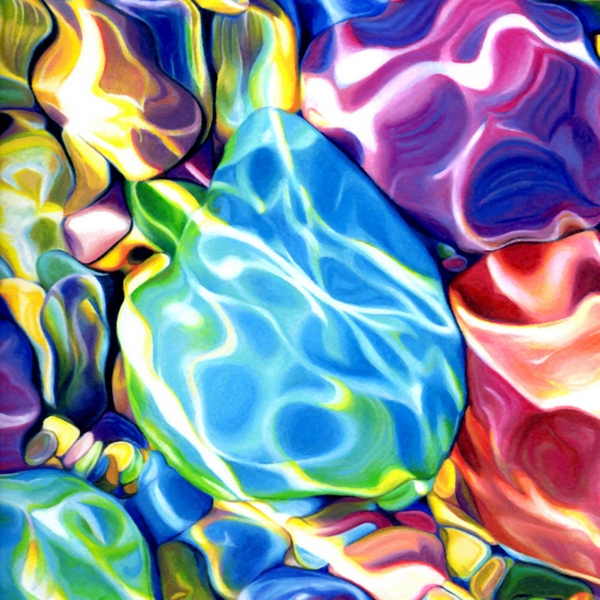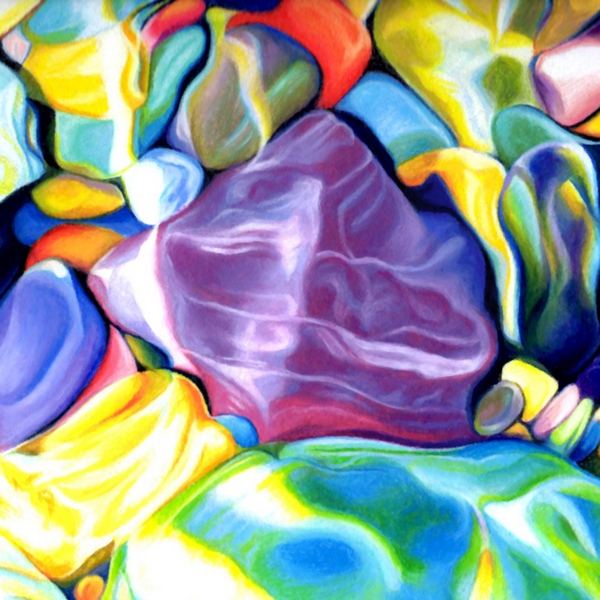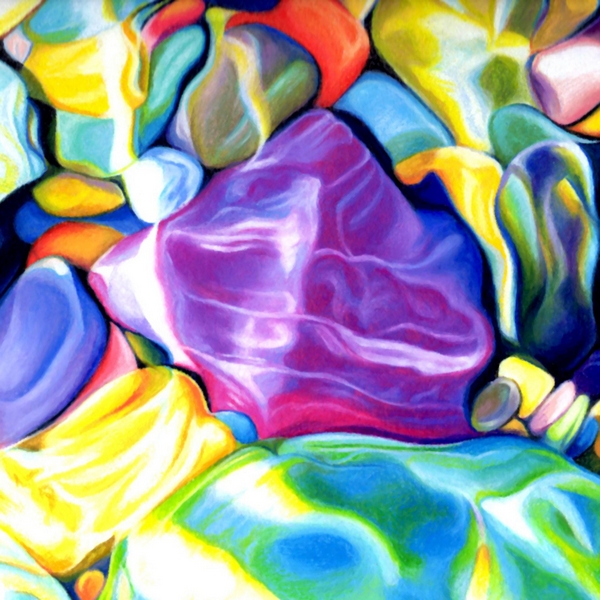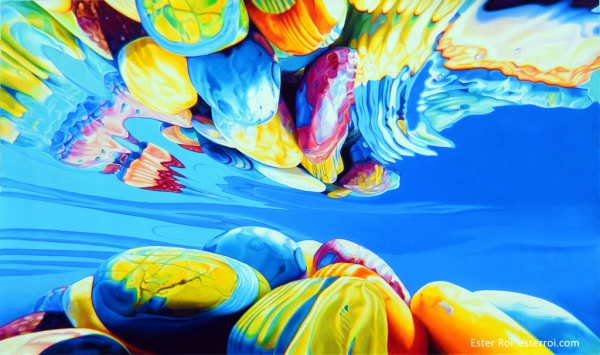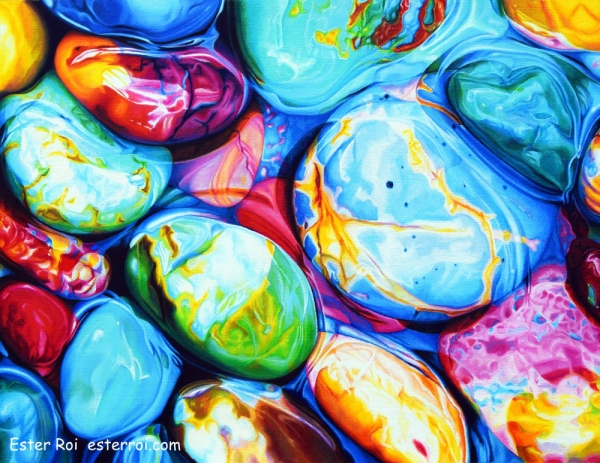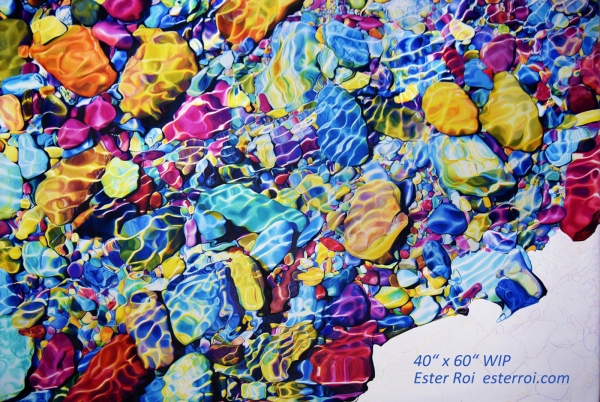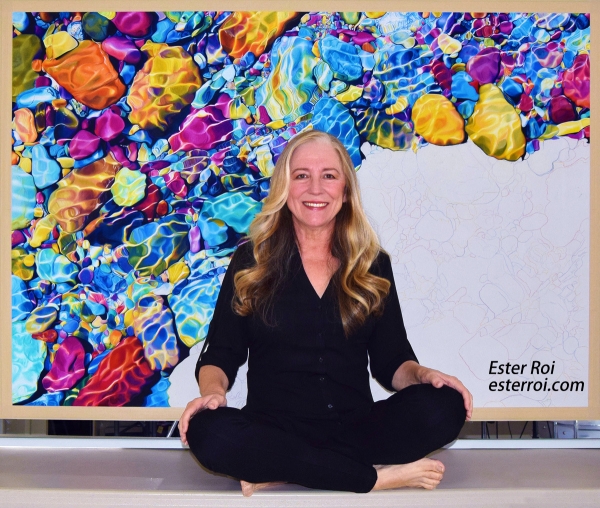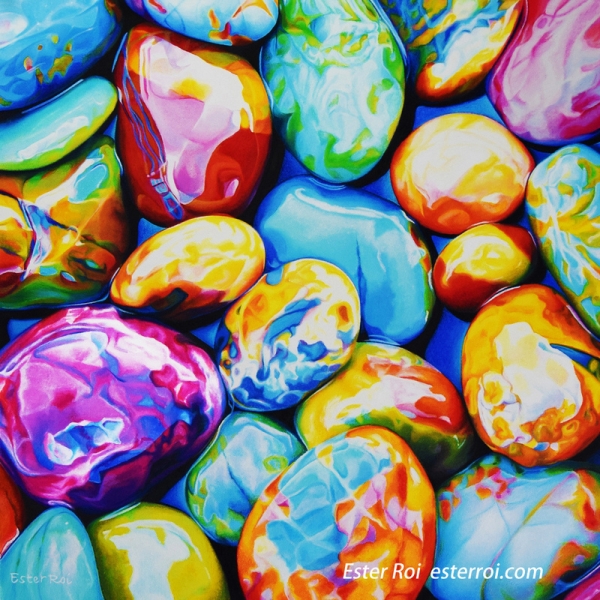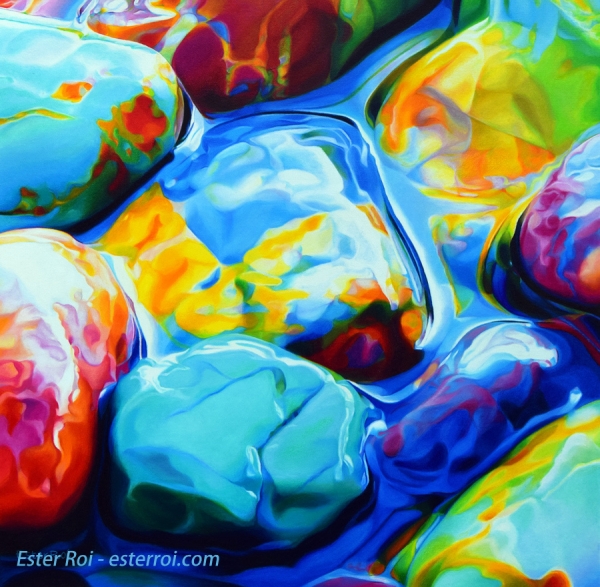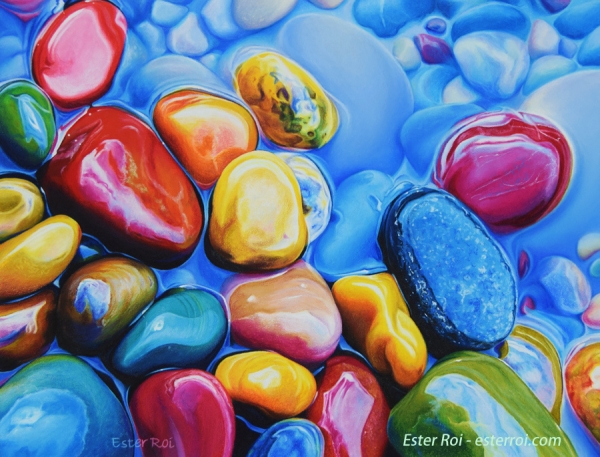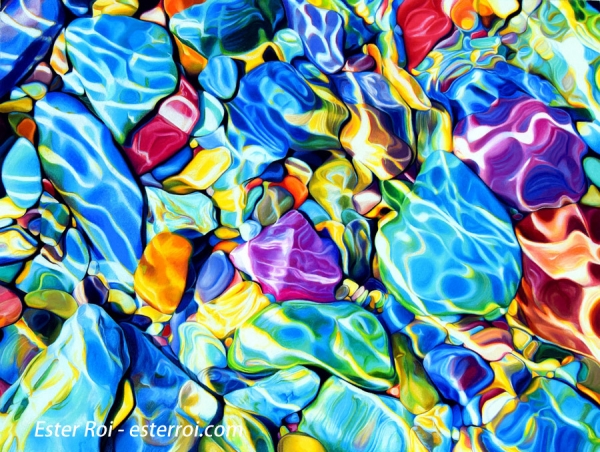
I'm working on a very detailed pebble piece. I'm combining Prismacolor colored pencil, Neopastel oil pastels & Neocolor artist crayons on Colourfix paper. I'm eager to show you a small (2"x2"), abstract close-up of my painting (18"x18") and explain the shortcuts I've taken to get around all the details.

1. Photo Cropping

2. Line Drawing
1. This is a cropping of the original photo. Even though it's very blurry you can still see all the intricate details.
2. On my line drawing I focus on the essential lines and not the confusing details.

3. Blocking-in Colors

4. Melting
3. On the cool zone I block-in the colors with a combination of oil pastels and artist crayons.
4. I move my artwork to the warm zone of the Icarus board (high temperature) and melt all the colors with a color shaper. The waxy pigments settle into the hills and valleys of the paper, leaving plenty of texture for further layering.

5. Preparing Eraser

6. Lifting Color
5. I'm preparing my Sakura battery-operated eraser by cleaning and flattening the tip on sand paper.
6. Here you can see how easily the pigment is lifted from the surface. By using the flat edge of the eraser point, I can achieve a very fine line.

7. Lifting Color

8. Finishing
7. I lift all the waxy pigments until the white of the paper shows through.
8. I can now develop the colors and values and finish the details with colored pencils. During this phase I lower the Icarus Board temperature to a medium setting.
This shortcut allowed me to work from "large" to "small" without getting bogged down in details too early in the process.
Blending artist crayon or oil pastel with colored pencil can be broken down into four steps.
- Step 1 - Layering artist crayon on the cool zone
- Step 2 - Melting artist crayon on the warm zone with a color shaper
- Step 3 - Layering colored pencil on the cool zone using side of pencil
- Step 4 - Blending artist crayon and colored pencil with a paper stump

1. Layering AC

2. Melting AC

3. Layering CP

4. Blending AC and CP
In the two examples below, you can see that this process can be reduced to two simple steps. While the colored pencil is blending with the crayon, it is also functioning as a melting tool.
This is a nice shortcut that works well for small areas. When blending large areas, I prefer to first melt the crayon and then layer and blend the colored pencil.

1. Layering AC

2. Melting and Blending
I love working with sanded pastel paper. My favorite is Colourfix Coated Pastel Paper by Art Spectrum. It's a wonderfully versatile archival surface that "withstands all manner of artistic experimentation." One of these, and not the least in order of importance, is the application of heat.
In the examples below you can see how I develop a flower petal with Prismacolor Colored Pencils and Caran d'Ache Neocolor II Wax Crayons.

Step 1

Step 2
Step 1: After finishing the first petal, I'm getting ready to begin the second one.
Step 2: On the cool zone and with sharp Neocolors, I block in all the local colors of the petal. The tooth of the paper easily captures the waxy pigments.

Step 3

Step 3 - detail
Step 3: After moving the paper to the warm zone, I begin melting the waxy pigments with a taper point color shaper. It's a simple process that can also be accomplished with a flat chisel color shaper (use the side of the tip for melting). This approach is much faster and gives you more control than adding water to Neocolor II. First of all there is no wait for the paper to dry - the melted pigments solidify as soon as the paper is removed from the heat - and the intensity and hue of the color do not diminish. Besides, it is so much fun I just can't get enough.

Step 4

Step 5
Step 4: The petal is now covered by a thin layer of melted pigments that I like to call "wax foundation."
Step 5: On the warm zone, with a sharp white Verithin I penetrate the previous layer and create fine ridges that will become the petal's veins.

Step 6

Step 6 - detail
Step 6: Here I'm developing the colors and the details of the petals. The layering of colored pencils is accomplished with Prismacolor Premier using the side of the pencil point. On the warm zone the waxy pigments melt and blend in with the foundation; on the cool zone they will sit on top for optical mixing. Sharp Verithin pencils are used for details and fine lines.
When using oil-based colored pencils with the Icarus Drawing Board, make sure to combine them with a wax-based medium. As you can see below, a thick layer of wax-based colored pencil is necessary to make the oil-based one as blendable as its wax counterpart.

Oil-based and Wax-based Colored Pencils
The starry sky of "The Butterfly Effect" could not have been accomplished in colored pencil without the Icarus Drawing Board. The choices would have been to painstakingly draw the blue sky around the white of the paper or to paint masking fluid over hundreds of stars. Instead I came up with the following technique:
Step 1: I laid down several different blue Neocolors II on the warm zone.
Step 2: I used a gray paper stump to thin and blend the crayons on the warm zone. This is accomplished by making small circles with the paper stump while cleaning the excess wax with a paper towel.
Step 3: I kept on working until the colors were evenly blended.

Step 1

Step 2

Step 3
Step 4: I grated a blue colored pencil on a sand paper block.
Step 5: I shook the blue speckles over the crayon background.
Step 6: I grated a white colored pencil on coarse sand paper.

Step 4

Step 5

Step 6
Step 7: I shook the white speckles over the crayon background.
Step 8: After placing a sheet of tracing paper over the colored pencil speckles, I pressed down with a brayer on the warm zone.
Step 9: The speckles melted into the blue background and created a starry sky effect.

Step 7

Step 8

Step 9
For another example of "speckling" see Snake River Pebbles.
Posted on December 06, 2009 · Comments Off
On step #1 I layer on the cool zone process red, pink and white colored pencils over light blue artist crayon (see more on "layering" on previous post). I use the side of the pencil, not the point.
After moving the paper to the warm zone I start blending with a paper stump. Here, again, I’m using the side, not the point, and make small circles as I blend. Step #2 shows you the blending in progress.
On step #3 you can see the end result: a very smooth and flawless color gradation. This technique will allow you to blend a large area in a very short time.

#1 - Color Gradation

#2 - Color Gradation

#3 - Color Gradation
Posted on December 06, 2009 · Comments Off
As you can see on step #1, it’s impossible to layer a hard medium over a softer one. The pink colored pencil can only make indentations and scratches over the light blue artist crayon. Here is where the Icarus Drawing Board can help you.
On step #2 the thick layer of crayon is thinned out on the warm zone with a gray paper stump. I use the side, not the point of the paper stump and make small circles until I'm left with a thin, saturated layer of color.
After moving the paper to the cool zone, I’m now able to easily layer colored pencil over artist crayon (see step #3).

#1 - Layering Colored Pencil Over Artist Crayon or Oil Pastel

#2 - Layering Colored Pencil Over Artist Crayon or Oil Pastel

#3 - Layering Colored Pencil Over Artist Crayon or Oil Pastel
Posted on July 02, 2009 · Comments Off
A new step-by-step of "Round-n-Round" is ready for viewing on Icarus Art website.

Round-n-Round (1)

Round-n-Round (2)

Round-n-Round (3)

Round-n-Round (4)
All entries preceding December 1st, 2009 were transferred here from my previous website.
Read more.
Posted on February 26, 2009 · Comments Off
Here is a step-by-step of "Rose Petal". You can view it in its entirety on Icarus Art website.

Rose Petal (1)

Rose Petal (2)

Rose Petal (3)
All entries preceding December 1st, 2009 were transferred here from my previous website.
Read more.
Posted on February 26, 2009 · Comments Off
Check out the new step-by-step of "Snake River Pebbles" on Icarus Art website.

Snake River Pebbles (1)

Snake River Pebbles (2)

Snake River Pebbles (3)
All entries preceding December 1st, 2009 were transferred here from my previous website.
Read more.