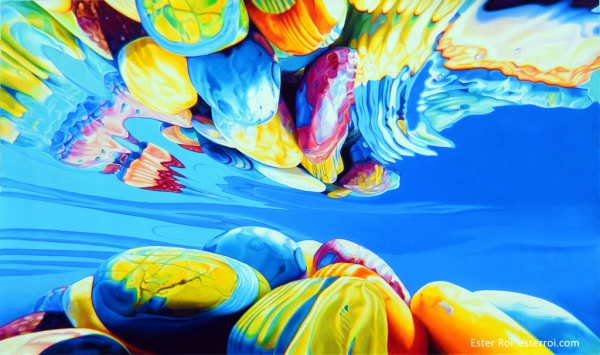
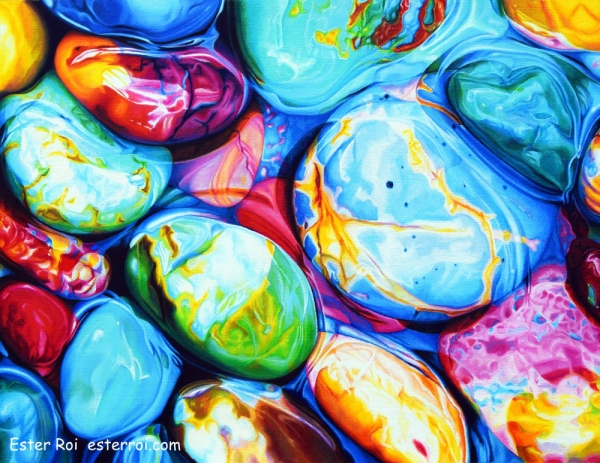
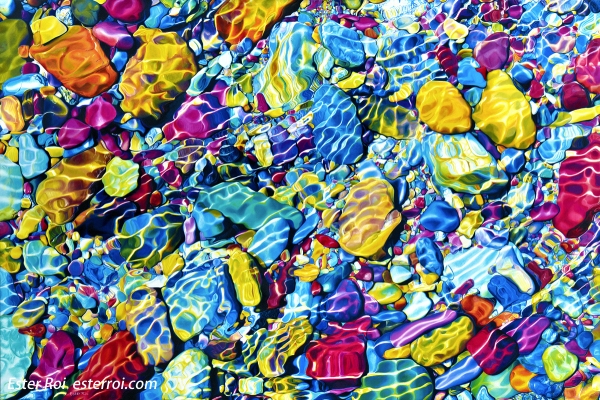
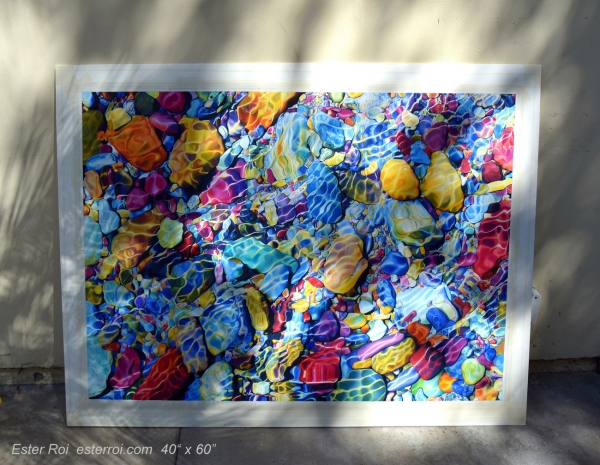
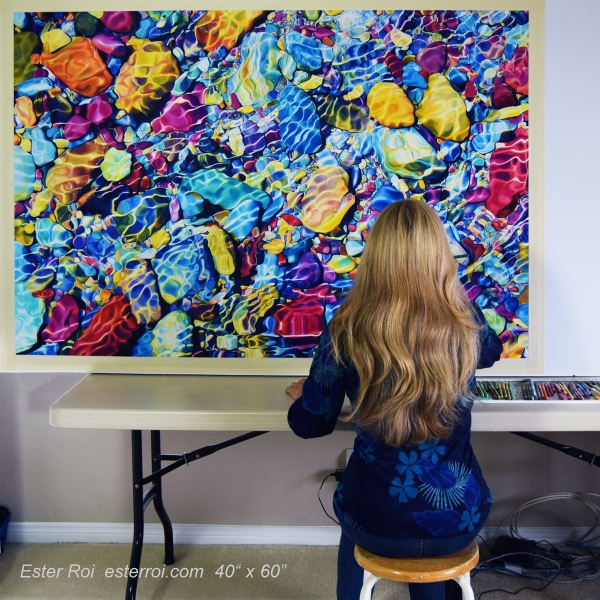
River Pebbles, No. 4

Title: River Pebbles, No. 4

Color Mapping with Artist Crayons - Cool Zone

After drawing the outline with Verithin colored pencils on the cool zone of the Icarus Drawing Board, I proceeded to map the main colors of the project with Neocolor artist crayons on the cool zone.

For more on color mapping with artist crayons you can view the following videos:

Artist Crayons Melted - High Temperature

With temperature setting at maximum, I melted the artist crayons using a clay shaper (color shaper).

For more on melting artist crayons you can view the following videos:

Orange Pebble Finished in Colored Pencil - Medium Temperature

With the temperature set at medium I developed the colors, values and details of the orange pebble by layering colored pencils and blending them with a tortillion.

Blue Pebbles Finished in Colored Pencil - Medium Temperature

The blue pebbles were accomplished in the same manner as the orange pebble.

Red Pebble Finished in Colored Pencil - Medium Temperature

I finished the drawing by completing the red pebble in the same manner as the other pebbles.

Clean-up, Highlights and Signature

Finally I cleaned up the drawing and emphasized the highlights with a white artist crayon. I like my signature to blend in and I can achieve that by using a sharp, white Verithin on the warm zone. It lightens the colors underneath just enough to make the letters visible without detracting from the art.

Paper Stump and Tortillion

When I first started experimenting with heat I was always on the lookout for different tools that would work with my technique. I remember trying tortillions and disliking them. I found that I couldn't really use them by the long side of the point because they would leave indentations/ridges on the waxy pigments.

The paper stumps that I normally use for large artwork were too thick and soft for this small project. At the same time I was getting very frustrated with how inconsistent the various colorless blenders have been lately. Finally I decided to give the tortillion another try and, guess what? It works great! The point is very thin and sturdy, not as soft as the paper stump's, perfect for blending colored pencils. It's easy to clean with sandpaper and very inexpensive. If you're using it already, you're way ahead of me. If you're not, try one and you'll be pleased!

Title: River Pebbles, No. 3

Outline - Cool Zone

The outline was accomplished with Verithin Colored Pencils on the cool zone of the Icarus Drawing Board.

Color Mapping with Artist Crayons - Cool Zone

For more on color mapping with artist crayons you can view the following videos:

Detail View of Color Mapping

Here you can see the pigment density needed to achieve complete paper coverage after melting.

Melting Artist Crayons - Warm Zone

With temperature setting at maximum, I begin melting the artist crayons with a clay shaper (or color shaper).

For more on melting artist crayons you can view the following videos:

Melting Completed

Artist crayons save me a lot of time. After they are melted, the paper becomes completely saturated with vibrant colors. The waxy pigments make an ideal substrate for layering colored pencils on top.

Finished Artwork

With temperature setting at medium, I finally layer and blend colored pencils to develop colors, values and details.

You can see a slideshow of this project on the following blog post: Slideshow of "River Pebbles, No. 3".

"River Pebbles, No. 3"

River Pebbles, No. 3

Title: River Pebbles, No. 3

In my follow-up post of River Pebbles, No. 3, I will show you how I used Neocolor Artist Crayons with heat.

"Four River Pebbles" Project on YouTube

Four River Pebbles

I've just posted the five part video series "Four River Pebbles" to our Icarus Art YouTube Channel. It's a collection of 57 video clips from my 2010 CPSA workshop "Wax and Heat, a Match Made in Heaven".

This project, which was accomplished on white Stonehenge paper with Prismacolor Colored Pencils and Caran d'Ache Neocolor II Artist Crayons, is divided into the following five sequential playlists:

1. Beige Pebble
2. Green Pebble
3. Yellow Pebble
4. Red Pebble
5. Shadows and Water

For my workshop attendees this is a great opportunity to review the techniques learned in Santa Clara, California. For everybody else it's like taking a workshop for free. All voiced-over video clips are available in high definition and come with a downloadable supply list, an outline of the project, and an image of the finished project.

I hope you will enjoy practicing and/or learning the Icarus technique. You are always welcomed to post comments and ask questions either on this blog or on our YouTube Channel.

"Mussel Shell" Project on YouTube

I just posted a new playlist of 17 video clips on our Icarus Art YouTube Channel. It's a condensed, sixty-minute video library of  a project called "Mussel Shell" from my 2010 CPSA workshop "Wax and Heat, a Match Made in Heaven".

For my workshop attendees this is a great opportunity to review the techniques learned last summer. For everybody else it's like taking a workshop for free. All voiced-over video clips are available in high definition and come with a downloadable supply list, an outline of the project, and an image of the finished mussel shell.

I hope you all enjoy practicing and/or learning the Icarus technique. You are always welcome to post comments and ask questions either on this blog or on YouTube.

View this playlist on Youtube.

"Social Network"

Social Network

22" x 28" - Wax-based Media (Colored Pencil and Artist Crayon)
Created with the Icarus Drawing Board.

I finished this piece just in time to enter it into the 19th Annual CPSA Juried Exhibition. There's something about this group of pebbles, linked together by water, that reminded me how we are all connected, socially and otherwise.

This year the Colored Pencil Society Convention will be in Dallas, Texas. I will be demonstrating the Icarus board at the CPSA trade show Saturday, July 16, from 9:00 to 2:00.

I have a short demonstration coming up on Saturday, April 30th, in conjunction with the Los Angeles CPSA district chapter meeting. Click this link for directions.

"River Odyssey"

River Odyssey

14" x 22" - Wax-based Media
Created with the Icarus Drawing Board.

"Fire and Ice"

Fire and Ice

18" x 18" - Wax-based Media (Colored Pencil, Artist Crayon, and Oil Pastel)
Created with the Icarus Drawing Board.

This is my latest work in my pebbles series - a very abstract approach to nature. I took this picture in my studio and I've had the hardest time balancing the colors correctly. I'm fairly satisfied with the results but as soon as I get a professional scan, I'll decide if this image will need to be replaced.

I've had a lot of fun with this project, the subject of which is a group of pebbles I collected on Moonstone Beach in Cambria.

It will be my entry for Explore This! 7, a Colored Pencil Society juried online exhibition which will be on display on the CPSA website for one full year, from February 1, 2011 through January 31, 2012.

Edit (10/24/10): you can read about the specific technique I used for this artwork on a previous post titled A Shortcut for Details.

A Shortcut for Details

I'm working on a very detailed pebble piece. I'm combining Prismacolor colored pencil, Neopastel oil pastels & Neocolor artist crayons on Colourfix paper. I'm eager to show you a small (2"x2"), abstract close-up of my painting (18"x18") and explain the shortcuts I've taken to get around all the details.

1. Photo Cropping

2. Line Drawing

1. This is a cropping of  the original photo. Even though it's very blurry you can still see all the intricate details.

2. On my line drawing I focus on the essential lines and not the confusing details.

3. Blocking-in Colors

4. Melting

3. On the cool zone I block-in the colors with a combination of oil pastels and artist crayons.

4. I move my artwork to the warm zone of the Icarus board (high temperature) and melt all the colors with a color shaper. The waxy pigments settle into the hills and valleys of the paper, leaving plenty of texture for further layering.

5. Preparing Eraser

6. Lifting Color

5. I'm preparing my Sakura battery-operated eraser by cleaning and flattening the tip on sand paper.

6. Here you can see how easily the pigment is lifted from the surface. By using the flat edge of the eraser point, I can achieve a very fine line.

7. Lifting Color

8. Finishing

7. I lift all the waxy pigments until the white of the paper shows through.

8. I can now develop the colors and values and finish the details with colored pencils. During this phase I lower the Icarus Board temperature to a medium setting.

This shortcut allowed me to work from "large" to "small" without getting bogged down in details too early in the process.

Time Saving Tip on Blending

Blending artist crayon or oil pastel with colored pencil can be broken down into four steps.

  • Step 1 - Layering artist crayon on the cool zone
  • Step 2 - Melting artist crayon on the warm zone with a color shaper
  • Step 3 - Layering colored pencil on the cool zone using side of pencil
  • Step 4 - Blending artist crayon and colored pencil with a paper stump

1. Layering AC

2. Melting AC

2. Melting AC

3. Layering CP

4. Blending AC and CP

In the two examples below, you can see that this process can be reduced to two simple steps. While the colored pencil is blending with the crayon, it is also functioning as a melting tool.

This is a nice shortcut that works well for small areas. When blending large areas, I prefer to first melt the crayon and then layer and blend the colored pencil.

1. Layering AC

2. Melting and Blending